If you like trekking in natural sites, seeing beautiful landscapes and witnessing first-hand a part of Japan's history, you cannot miss walking through a section of the Nakasendo Trail in Japan.
During the month I was traveling through Japan, back in 2019, I had already planned to dedicate a day of my travel itinerary to walk part of this ancient route.
This post may contains affiliate links. If you purchase through these links, I may earn a commission at no extra cost to you. Thank you for your support!
Table of Contents
What is the Nakasendo Route?
Nakasendo It was one of the five main routes of the Edo period and one of the two that connected Edo (present-day Tokyo) with Kyoto in Japan.


Along the entire route there were 69 stations between the two cities, which crossed different provinces of ancient Japan.
Unlike the route of Tokaido, who was going along the coast, Nakasendo It was located inland. Many people preferred to travel this way because it didn't require fording any rivers.

This trek is part of my travel itinerary through Japan and South Korea. If you want to read the rest of the stories, you can start there.
To this day, few sections of the original trail survive and perhaps the most famous section, and the one that most visitors like to walk, is one of almost eight kilometers de largo localizada en el Valle Kiso, entre Tsumago en la prefectura de Nagano y Magome en la prefectura de Gifu.

In addition, if you wish, you can continue a few more kilometers to reach the city of Nagisio (this section is also part of the Nakasendo route).

Another well-known trek that can be done is to climb to the top of Mount Fuji. In this post you can read the full experience of climbing the most famous mountain in Japan.


How to do the Nakasendo Route
This route can be taken either starting from the village of Tsumago and heading towards Magome, or vice versa.
In my case, I decided to start from Magome heading towards Tsumago for two reasons. The first is that there is less uphill road, so it may be more enjoyable to travel; and the second (and most important) is that my final destination was to reach the town of Nagisio, which is located 4 km past Tsumago, to take the train back to Matsumoto, city where I was staying.

I wrote about Matsumoto in this article about the Castle Route
How to get to Magome
Getting to Magome Town depends on which city you're coming from. It could be from Nagoya, Matsumoto, or Nagano, for example. I was in the city of Matsumoto and I chose to take a JR line train to the city of Nakatsugawa (ver precios y horarios).
The ticket price (if you don't have the JR Pass) can range from $12 to $25 USD, depending on whether you take the express train, which takes 75 minutes, or the regular train, which takes approximately 2 hours and 20 minutes.

As my plan was do the Nakasendo Route in one dayI had to leave Matsumoto early and return later. So I took the fast route, as I didn't want to be too late to get started.
Once in the city of Nakatsugawa, we must take a bus that leaves from platform 3, just outside the train station. It's the Magome Line Bus, costs 560 yen, and takes about 30 minutes to reach Magome.
Map of the Nakasendo Route between Magome and Tsumago
Magome
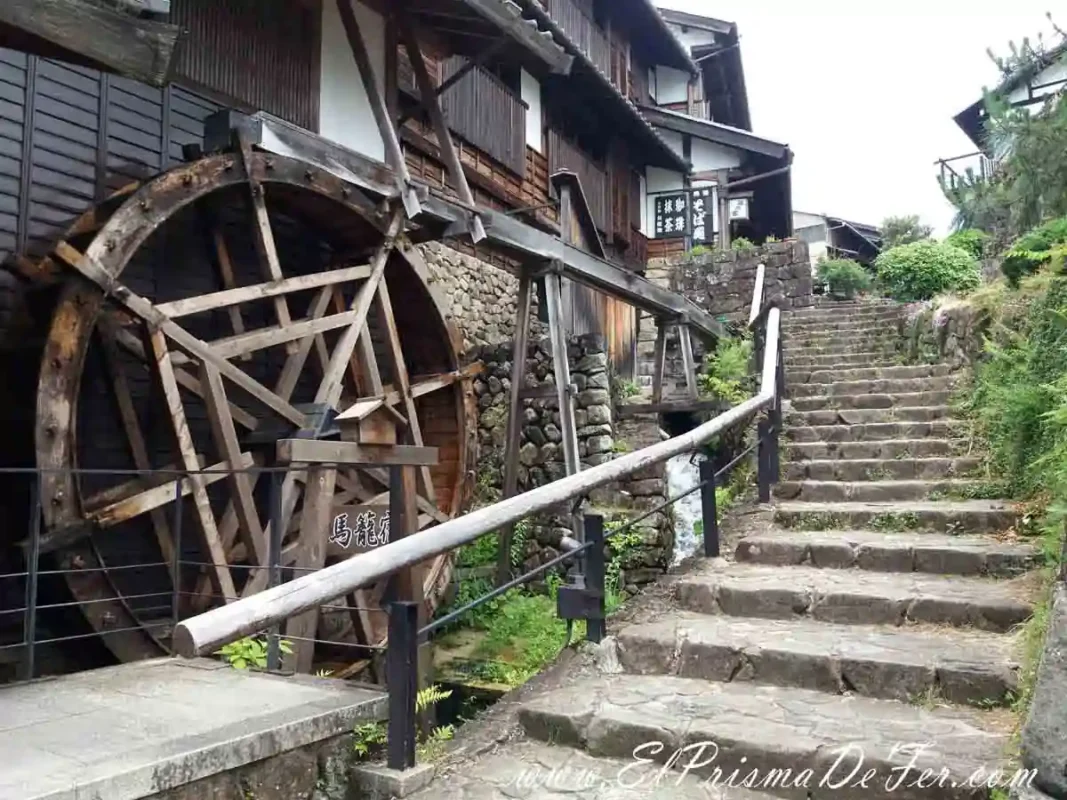
Magome was once a very prosperous and cosmopolitan station with a thriving economy. However, with the construction of the main railway line, which bypassed Magome, it fell into oblivion and decline.

In recent decades it has been restored to its appearance as it was in the Edo period and is currently a major tourist destination.

Where the Nakasendo Trail begins in Magome
If we continue along the main street that runs through Magome to the end, we will reach a viewpoint with incredible views of the entire area around us (see location on the map). From there, we will begin the trail towards Tsumago.

Route between Magome and Tsumago
The trail connecting the two towns is 7.7 kilometers long, winding through forests, streams, and asphalt, with ups and downs.

We follow practically the entire trail along the paved road that connects the two towns, so the experience isn't 100% natural. While it's not a busy route, we'll occasionally see a car coming and going.
The trail is perfectly signposted in English and Japanese, and every few meters you'll find signs showing your progress, location on the map, and even some bells to ring and scare away any bears you might encounter along the way...yes, bears. Let's just say that having an up-close encounter with them isn't something that happens very often, but just in case, ringing those bells might scare them away...or not? 😀

Some interesting places we can see along this route, besides the nature around us of course, are:
- The tea house Tateba-chaya, formerly a roadside inspection house, now a rest house where you can buy drinks or food.
- Some beautiful waterfalls called Odaki and Medaki, an ideal place to stop and rest for a while or have something to eat
- Finally, the small village of Otsumago, where we can find some traditional and rural houses that offer accommodation or some other service.

Arriving at Tsumago Village
After a couple of hours of walking, depending on our pace, we will arrive at the village of Tsumago.

Like Magome, Tsumago was a prosperous and cosmopolitan city in old Japan that fell into decline with the arrival of the train. Since 1968, local residents have been working to restore historic sites and structures within the city.
Today Tsumago is fully inhabited, although tourist shops are the town's main business.

Tsumago has certain places of interest to visit, such as:
- The honjin, which was the main inn in the post town (it was rebuilt in 1995)
- The Nagiso History Museum, which contains information on the history of the areas and the preservation of houses.
- Kabuto Kannon Shrine: a small shrine dedicated to Minamoto no Yoshinaka, the general of the Rising Sun, who built the citadel at Tsumago.
- Tsumago Castle: or rather, the ruins of what was once the castle. Its location on the mountaintop gave it wonderful views of both Tsumago and Midono.
- Rurisan Kotoku-ji Temple: With its white walls and stone base, it rises a story above the buildings in the area.

Should you continue to Nagisio when doing the Nakasendo Route?
Generally, many travelers arrive in Tsumago and end their trek. Some buses depart from there to other nearby towns (check the schedule), but if they want to take the train to another city, they should continue to the town of Nagisio.
It's a much less frequented road and with views not as interesting as those of Magome and Tsumago, but since it has a train station, which in my case would take me back to Matsumoto, I kept going.
Nakasendo route between Tsumago and Nagisio
As we begin this route, we'll see a sign indicating that we can take a temporary detour to the ruins of Tsumago Castle. Obviously, eager to see as much as I could, I headed there. It's an extra 15 minutes of climbing until we reach the top of a hill. There we'll find... what was once a castle?
I don't know what it was, because practically nothing remains of the castle beyond some scattered rocks, but at least we'll see some very good views of the valley we just walked through.

Then, we return to the original path and continue toward Nagisio. The trail is pleasant and not at all challenging. We'll see some rice fields and several houses belonging to local residents.

Finally, we're nearing the end of the road. As we enter the city, we can already see the tracks where the train will pass that will take us to our destination.

Not in a hurry this time, I took the train back to Matsumoto City. It cost 1,400 yen but took over two hours. Otherwise, there's the express train, which costs approximately 2,400 yen (both included in the JR Pass).

If you are interested in Japan, you can read the stories I wrote about it. Tokyo: the city of my dreams, Kyoto, the cultural capital and Osaka, lights and retro with some disappointment
Save this post on Pinterest

Reflections on my experience doing the Nakasendo Route
I love hiking in natural places far from the hustle and bustle of modern civilization. I went on this trek with high expectations, hoping to transport myself back to the ancient times and splendor of this beautiful country.

But unfortunately, I never felt that special. I enjoyed hiking this ancient route and would even recommend it, but I personally had imagined something else. The best part of the trip, for me, was the towns of Magome and Tsumago, picturesque villages with that Edo-era facade, but updated for modern times and geared toward the tourism industry. The adventure or trekking took a backseat.
I was expecting something more mystical, rugged, and desolate, perhaps even a bit more challenging to hike. But the fact that I had the paved road beside me almost the entire time, seeing cars pass by now and then, or coming across tea houses or souvenir shops along the way, and even having Wi-Fi the whole way, somewhat diminished my excitement.
Furthermore, since everything was so perfect, tidy and comfortable (something very common in Japan and a source of admiration for me), it felt more like a circuit to do on autopilot than like an ancient adventure.
It's not that I didn't like it, but I had different expectations. In any case, if you're in the area, I recommend setting aside a day to visit these towns. They're very picturesque and well worth a visit.
Frequently asked questions about the Nakasendo route
What is the Nakasendo route?
The Nakasendo was an ancient route that connected Kyoto with Edo (present-day Tokyo) during the Edo period. Today, some of its best-preserved sections allow you to walk through traditional villages and relive a bit of that historical experience.
Which section is the most popular?
The most famous section is Magome – Tsumago. It's about 8 km long, well signposted, with forests, waterfalls, and very well-preserved villages.
How long does it take?
You can do the classic section in half a day or a full day. If you want something more comprehensive, you can add other sections and dedicate 2 or 3 days to it.
Is the hike difficult?
No, it's quite accessible. It has some uphill sections, but overall it's an easy to moderate trek, suitable for most people.
Is it possible to do it without a guide?
Yes, absolutely. It's very well signposted in English and Japanese, so there's no need to hire a guide.
What is the best time to do it?
Spring (March–May) and autumn (September–November) are the best times to visit, due to the weather and the scenery. In autumn, the colors are especially spectacular.
How do I get to the start of the trek?
The most common way to get there is by train to Nakatsugawa or Nagiso, and from there take a bus to Magome or Tsumago. Everything is well connected and easy to arrange.
Where to sleep?
You can base yourself in Magome or Tsumago, or sleep in a traditional ryokan.
Do you need to bring a lot of equipment?
No. Comfortable clothing, appropriate footwear, water, and some food are sufficient for the classic stretch.
Is the Nakasendo route worth doing?
Yes, but with realistic expectations. It's a good way to combine nature, history, and traditional Japanese culture in a short and accessible experience. But it's not a trek where you'll see epic landscapes or imagine yourself in the past.
Support The Prism of Fer!
Your support helps me continue creating free content on the blog. Thank you so much!