Trekking in the Fann Mountains was one of the experiences that marked me the most during my time in Tajikistan.
I decided to tackle the hike from the Hotel Artuch Alplager to the Alauddin Pass, crossing the incredible Kulikalon Lake, in the heart of the mountains. A route that combines the best of the Tajik landscape: turquoise lakes, snow-capped peaks, secluded trails, and breathtaking nature.
While Tajikistan is famous for the Pamir Highway, for me this stretch in the Fann Mountains was just as impressive, and even more accessible in terms of logistics and physical effort.
I experienced it as a short but very complete trek, ideal for those looking to walk on their own among valleys and mountains while still feeling that sense of isolation, immensity and beauty that so well defines this country.
In this post I'm going to tell you how to do the trek from Artuch Alp Camp to the Kulikalon Lakes and the Alauddin Pass, with practical information on how to get there, times, difficulty and what to expect from the trek in the Fann Mountains, one of my favorite places in all of Central Asia.

This post may contains affiliate links. If you purchase through these links, I may earn a commission at no extra cost to you. Thank you for your support!
Table of Contents
🗺️ Technical information for Trekking in the Fann Mountains: Artuch – Alauddin Pass
| Start |
| Hotel Artuch Alplager |
| Final |
| Alauddin Pass – Hotel Artuch Alplager |
| Duration |
| 1 day |
| Distance |
| 24 km |
| Estimated time in hours |
| 12-14 hs |
| Max. Altitude |
| 3800m |
| Difficulty |
| Moderate (by km) |
| Signaling |
| None, but well-marked trails |
| Water/food |
| None |

Do you want to follow this route precisely?
Download the KML/KMZ file of the Alauddin Pass trek, starting from Artuch Alplager and crossing Lake Kulikalon, and open it in apps like Maps.me or Gaia GPS to view the complete route offline. This is ideal if you want to navigate the valley with confidence, even without a signal.
Download the route to Alauddin Pass on Gumroad for a small contribution.

🚐 How to get to Hotel Artuch Alplager from Panjakent
The starting point for this trek in the Fann Mountains is the Hotel Artuch Alplager, located about 70 km southeast of Panjakent. Although the distance does not seem far, access is not so direct and can take several hours, especially in the last section, which is gravel and mountainous.
From Panjakent you have two main options:
🚕 Private taxi
The most practical (but also most expensive) way is to hire a private taxi to the hostel. The journey takes between 2.5 and 3.5 hours, depending on the road conditions.
- Estimated price: between 250 and 350 somoni (approximately 20–30 USD), although it may vary depending on the season and your bargaining skills.
🚗 Shared taxi + extra ride
Another cheaper option, but with an extra step, is:
- Take a shared taxi from Panjakent to the village of Artuch (see location on the map and ask for vehicles going to Artuch).
- From there, arrange for someone to take you the last 7-8 kilometers to the hostel, either by negotiating with the same taxi that brought you to the village, with a local, or by hitchhiking. This part of the trail is more isolated and mostly uphill, so it may take some time.
📌 Advice: Si te alojás en Panjakent, algunos hostels pueden ayudarte a coordinar el transporte al Artuch Alplager, o incluso armar grupos para compartir costos con otros viajeros.
How to get to Artuch from the border with Uzbekistan?
If you cross the border between Uzbekistan and Tajikistan through the pass near Panjakent (one of the most used, coming from Samarkand), getting to Artuch Alp Camp is quite straightforward.
Once you cross the border, the first thing to do is take a shared or private taxi to the center of Panjakent, which is about 15–20 minutes away. From there, you'll need to negotiate another taxi (usually a shared one if there are other passengers) to take you to Artuch/Alplager. This second leg takes between 1.5 and 2 hours, along a mountain road that may be in fair condition in some parts.
There's no direct public transport to Artuch, so a taxi is practically the only option. If you're traveling alone, you might have to wait for other people to join you or pay for the entire trip.
In total, from the border to Alplager, allow between 2 and 3 hours of travel, depending on waiting times and road conditions. It's a fairly common route for travelers exploring Uzbekistan who cross over to trek in the Fann Mountains.

🏙️ Panjakent: Useful, but not very charming, waypoint
Panjakent wasn't a city I particularly liked. It has a somewhat chaotic and uncharming center, and beyond a couple of monuments and markets, it doesn't offer many major tourist attractions.
However, from here you can organize your visit to the Fann Mountains, such as going to the Artuch area and Lake Kulikalon, trekking to the Seven Lakes, or cross the border into Uzbekistan if you are coming from or going to Samarkand.
In that sense, Panjakent serves its purpose as a base of operations or a stopover, with some affordable accommodations and basic services to stock up on before continuing on your journey.
I stayed at Salom Hostel and I truly recommend it for its good vibes, facilities, and the friendly owners. It's common to meet other travelers who want to trek to the Fann Mountains or even people going to or from Uzbekistan. It's an ideal place to get organized and, hopefully, get together with others to reduce transportation costs.
🥾 Useful tips for trekking in the Fann Mountains
Trekking in the Fann Mountains is a spectacular experience, and the great thing is that you can do it on your own without a guide, as long as you have some previous mountain experience and are comfortable with maps or offline navigation apps like Maps.me or Gaia.
 One advantage is that you can tailor the hike to how you feel: from short excursions around Kulikalon to multi-day treks connecting lakes and mountain passes. Even if you feel that a section is too challenging, you can always return along the same path or take alternative routes that are less difficult.
 Based at the Hotel Artuch Alplager, you don't need to bring a tent or cooking equipment, as the place offers simple but comfortable rooms, and you can also have your meals prepared, which makes logistics much easier.
 The maximum altitude I reached was approximately 3800 masl at the Alauddin Pass, so while it's not extreme, it's a good idea to acclimatize a bit if you're coming from lower areas.
 The paths are marked and traveled by other travelers in season, and there are several possible routes, depending on how much time and energy you have.
 I highly recommend using Maps.me with the downloaded map of the area. The app has marked walking trails around the Fann Mountains. You can mark your route beforehand or record the track as you walk.
📅 When is the best time to trek in the Fann Mountains?
The best time to visit the Fann Mountains is from late June to mid-September, when weather conditions are most stable, the mountain passes are clear, and the lakes reach their most intense colors.
- June: The landscape is beginning to awaken, with snow still melting at altitude. It's a good time if you want to avoid crowds, but some passes may still be snow-covered.
 July and August: These are the ideal months. The days are long and sunny, the temperatures are pleasant (although cool at night), and all roads are accessible.
 September: Still a good option, especially in the first half. The weather starts to get cooler and there are fewer people, but the autumn colors give the landscape a special charm.
 Off-season (October to May), many trails become inaccessible due to snow, the Hotel Artuch may close, and the weather is generally not conducive to safe trekking.

🏞️ Another popular option: the 7 Lakes trek
In addition to the Kulikalon and Alaudin Pass treks, the Seven Lakes (also known as Haft Kul) route is also very popular in the Panjakent region. This is a shorter and more accessible route, ideal for those who want to explore the beauty of the Fann Mountains without having to hike at high altitudes.
This trek can even be done in a single day if you have a vehicle, as there is a gravel road that runs along the seven lakes, one after the other, each with its own shade of blue or green, surrounded by small villages and mountains. It is also possible to do it on foot, in two or three days, sleeping in local homes or camping.
It's an excellent option for those short on time or who prefer easier hikes. In my case, I opted for the trek from the Artuch Hotel to the Alauddin Pass, passing through Kulikalon Lake, which is more mountainous and challenging. I'll describe that trek in detail in this post.

Organized activities in the Fann Mountains
Guide Map for Trekking in the Fann Mountains
Day 1: Short trek to Chukurak and Kuli Lakes
| Distance |
| 6 km round trip |
| Estimated time |
| 3-4 hs. |
| Elevation Profile |
| From 2.200 mts to 2.800 mts |
The same day I arrived at the Artuch Hotel, I decided to do a short trek to Lakes Chukurak and Kuli. It's an easy hike that can be completed in a couple of hours round trip, without much physical exertion.
It's not an epic route or one with stunning scenery like others in the region, but it is a nice introduction to the mountain environment, ideal for starting to connect with the tranquility of the place and stretching your legs after the journey.

Depending on the time of year you go, the lakes can look very different: for example, when I went in September, Kuli Glacial Lake was dry, which took away some of the drama from the landscape. Still, it was a good way to get started and acclimatize for the days ahead.
Day 2: Trekking from Hotel Artuch – Alauddin Pass – Hotel Artuch
| Distance |
| 24 km round trip |
| Estimated time |
| 12-14 hs |
| Elevation Profile |
| From 2.200 mts to 3.800 mts |
Section 1: From Hotel Artuch to Lake Kulikalon
On the second day I started early, intending to reach Alauddin Pass, one of the highest points of the route.
The hike begins along a well-marked path that runs along the river, and soon passes by some local shepherds' houses, where it's common to see cows, donkeys, and goats roaming about. The slope is gentle, and you advance gradually between trees and small clearings.

After a while, you cross a kind of natural dam formed by an ancient rock collapse that blocked the passage of water and created a slope.

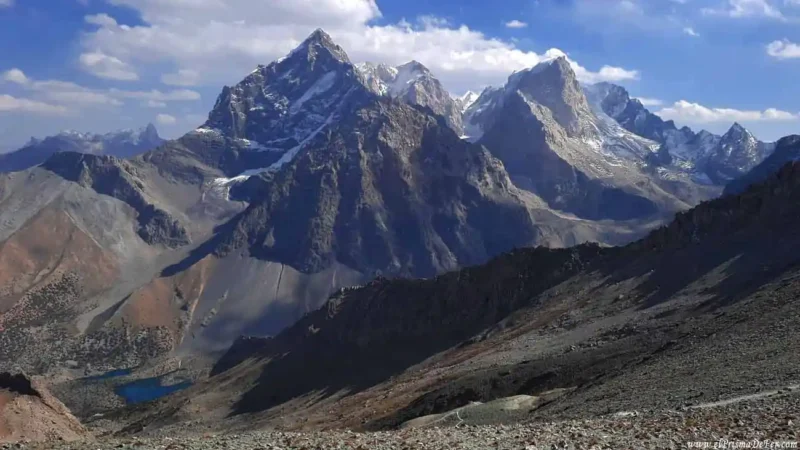
Once past that point, the trail suddenly opens up and the Kulikalon Valley appears, an incredible postcard with several lakes of different shades of turquoise, surrounded by snow-capped peaks.

Kulikalon Lake is the largest and most prominent lake in the landscape, but there are also smaller lakes that complete the scene. It's an ideal place to rest, take photos, and simply linger for a while, admiring the surroundings.

Section 2: Walking through the Kulikalon Valley
After arriving at Kulikalon Lake and taking a break, I experienced one of those mountain moments. While resting on the shore, I met some farmers tending their goats in the area.
They didn't speak a word of English, but they still offered me food and a smile, and I spent some time with them sharing that small, simple but unforgettable moment.

Then I continued walking peacefully through the valley, circling the various lakes that complete the landscape, each with a different color and shape, reflecting the mountains in their still waters.
I loved the unique combination of vegetation, crystal-clear lakes, and the craggy peaks that rise like rock walls in every direction. Without exaggeration, it was one of the most idyllic places I visited during my entire trip through Central Asia.

The Kulikalon Valley has something special about it. Not only for its natural beauty, but also for the feeling of being completely immersed in the mountains, far from everything, without people, surrounded by a peace that is hard to explain in words.

Section 3: The final climb to the Alauddin Pass (3800 m)
From the Kulikalon valley begins the third section, and probably the most demanding of the entire route: the climb to the Alauddin Pass, at about 3800 meters altitude.
Many hikers choose not to do it, since the elevation gain is considerable (1000 extra meters) and the entire stretch, round trip, can be long and hard, especially if you are not used to walking at altitude.

The trail begins by gently winding up the mountainside, but soon it starts to become increasingly steep, with rocky and steep sections that demand patience and strong legs.
Halfway along, I came across a local family taking care of their animals, and as at other points on the trek, it was another reminder that this area is not only a paradise for travelers, but also a territory of traditional life.

Finally, after a few hours of climbing, I reached the Alauddin Pass, and what I saw left me speechless. One of the best mountain views I've ever witnessed.
Down below, in the distance, the Alauddin lakes shone like gems among the rocks, while all around, an amphitheater of snowy peaks and vertical walls framed the horizon.

Tiredness disappears instantly when one is faced with such a sight.
While resting at the Alauddin Pass, I crossed paths with some hikers coming from the other side, from the Alauddin Lakes area. They were doing the trek as a longer loop, camping at different points and crossing from valley to valley.
It's entirely possible to explore the area over several days, linking Kulikalon, Alauddin, and other lakes, provided you have camping equipment and supplies. This option is ideal for those seeking a more comprehensive adventure, with nights under the stars and daily hikes through some of Tajikistan's most spectacular landscapes.

The return to the Hotel Artuch
After resting for a while at Alauddin Pass, it was time to start the return journey. I descended with a mixture of satisfaction and amazement, knowing that I had managed to ascend from the 2,200 meters of the hotel to the 3,800 meters of the pass, crossing some of the most impressive landscapes I had seen in Central Asia.

The descent was more physically manageable, but I enjoyed it with a different kind of energy. I had time, my body was tired but happy, and I allowed myself to walk peacefully through the Kulikalon Valley, passing by the lakes again.

I continued descending without haste, almost meditating on each step, until night surprised me near the hotel, with the starry sky appearing among the silhouettes of the mountains.
🚗 How to get back to Panjakent from Hotel Artuch
To return to Panjakent from the Artuch Hotel, there are two main options. The most convenient is to arrange a private taxi, which the hotel can arrange or you can schedule a local contact in advance. This option is faster, but also more expensive.
Another option is to walk down to the village of Artuch (about 7-8 km) and, from there, try to take a shared taxi to Panjakent. I opted for this second option, leaving the hotel early to arrive in the village around 10 a.m.
It turned out the shared taxi wasn't leaving until 1 p.m., and when the driver, who had just arrived, saw me, he invited me to his house to share a meal with his family while we waited. Although I didn't speak English, Tajik hospitality shone through once again, and that unexpected invitation became an anecdote I'll always remember.

Personal reflections on trekking in the Fann Mountains
I arrived in the Fann Mountains a little tired of so much mountaineering and intense hiking. I had just spent almost a month in Kyrgyzstan, doing a lot of trekking and then crossing the Pamir Mountains on my own, so my mind was already craving a change, something different.
I was really looking forward to getting to Uzbekistan and wasn't very enthusiastic about the idea of doing another trek in Tajikistan.
Honestly, I almost wouldn't have gone to the Fann Mountains if it weren't for the fact that several travelers highly recommended them. Without much expectation, I accepted the invitation, and today I can say it was one of the best decisions of the trip.

The Kulikalon region was one of the most beautiful areas I saw in all of Central Asia. Few people, natural lakes, and a spectacular mountain landscape that makes you want to stay longer and explore other corners.
In conclusion, the Kulikalon and Alauddin Pass trek not only exceeded my expectations, but ended up being one of the most beautiful areas of Tajikistan, and I definitely highly recommend it!
Save this post on Pinterest

Frequently asked questions about trekking in the Fann Mountains
Where are the Fann Mountains located?
The Fann Mountains are located in northwestern Tajikistan, near the city of Panjakent. It is one of the most accessible areas in the country for trekking, with spectacular landscapes of lakes and mountains.
Where does the Kulikalon trek begin?
The trek usually begins in the Artuch Alp Camp area (also called Alplager). Several trails start from there, including the one that leads to the Kulikalon lakes.
How long does the trek last?
The hike to Kulikalon Lakes can be done in one day round trip, although it is also common to do it in 2 days if you want to take it easier or combine it with other treks in the area.
What difficulty does it have?
It's a moderately difficult trek. There's a fair amount of elevation gain in some sections, but it doesn't require any technical experience. With a reasonable level of fitness and a good pace, it can be done without any problems.
Do we need a guide?
It's not mandatory. The trail is well-marked and is one of the most popular hikes in the area. However, if you'd like more context or added safety, you can hire a guide in Alplager.
How do you get to Alplager?
The most common way to get there from Panjakent is by shared or private taxi. The journey takes around 1.5 to 2 hours, depending on road conditions.
What to bring?
Water, some food, good hiking boots, and warm clothing. The weather can change quickly in the mountains, even in summer. Sunscreen is also recommended.
What is the best time?
The best time for trekking in the Fann Mountains is between June and September, when there is no snow on the passes and the trails are accessible.
It's worth it?
Yes, absolutely. It's one of the most accessible treks in Central Asia and offers very varied landscapes in a relatively short time, with lakes, mountains, and great views throughout the entire route.
Video of trekking in the Fann Mountains
Support The Prism of Fer!
Your support helps me continue creating free content on the blog. Thank you so much!