Tokyo was a city I dreamed of visiting since I was a child. As a lover of anime and Japanese culture in general, it was always a destination I considered essential to visit at least once in my life.
In this post, I'm going to tell you where this love affair with Tokyo began, which neighborhoods to explore, how to get around, and some key tips for making the most of your time. Tokyo has so much to see, but with a little planning, you can put together a very complete itinerary without going crazy.
This post may contains affiliate links. If you purchase through these links, I may earn a commission at no extra cost to you. Thank you for your support!
Table of Contents
Why did I dream of visiting Tokyo?
The first and foremost thing that made this trip a dream for me was…the ANIME, yes…Japanese cartoons (sin to call them that!!).
I grew up watching all kinds of anime that were on TV. We're talking about the '80s and '90s in Argentina. I mean, I watched Mazinger and Robotech, along with Captain Tsubasa, Saint Seiya, Dragon Ball Z, Samurai X, Evangelion, and an endless list of masterpieces that I still enjoy today.

That country would mark me for life. I'd love to walk those streets I'd so often seen destroyed by all kinds of monsters or robots, to hear the cicadas' song in the trees, or the bells ringing in the schools at the change of time.
My mind was waiting to go and find in every corner of the city any element that had a relationship with any of the many series I had watched since I was a kid.
But besides Anime, there are other reasons. I have a great admiration for the culture and history from Japan. I wanted to know more about the Samurai, discover how advanced they are in the Robotics, see how they were reborn from the ashes after the post-war period, and above all, experience first-hand what their way of life.
All that explosive cultural cocktail, plus the lively influence I had since I was a child, added to my insatiable thirst for travel, made this trip one of the most desired in my life.
Luckily, my high expectations were more than met :), although with some reservations that I will tell you about later.

This article is part of my travel itinerary through Japan and South Korea. If you want to see all the posts I've written so far, you can check it out.


What does Tokyo have that makes it so special?
Having already visited it, I have several things to highlight about Tokyo and Japan in general, things that have impressed me and I wanted to share them.
Spotless cleanliness
What has impressed me most since I set foot in Tokyo is the spotless cleanliness There's trash everywhere. I felt blessed to be in a brutal metropolis and not see a single piece of paper, bag, or food thrown away on the street. Accustomed to the filth we see in Buenos Aires and other Latin American cities, not finding any trash on the streets surprised and delighted me.

And not only that, but they won't find trash cans to throw away on the street. That is, if they have something to throw away, they save it and take it with them to the hotel, home, or some business that does have a trash can. This is something they themselves are proud of, as confirmed by an elderly woman I was lucky enough to speak with for a while.

If you are interested in more articles from Japan, Here is a story about medieval castles that I was able to visit in the country
Foreigner-friendly city
Tokyo is a city super foreigner friendlyTransportation, directions, and signs are at least in Japanese and English. I thought it would be more difficult to navigate the city without constant internet access on my phone, but that wasn't the case.
For example, in metro stations with many connections, there are signs and signals every 2 meters to guide you where you need to go and make the appropriate connection.
Efficient means of transport
He efficient means of transport What they have is another highlight. They can travel all over the city thanks to the extensive network of trains and subways.
Just by looking at a map of the network, you'll notice that wherever you need to go, you can always get there by taking the subway and walking just a few blocks.
The punctuality This is a welcome feature in services. When Google Maps told me the next train was arriving in 15 minutes, it actually arrived at that time. This helps optimize travel times, even when we have to take two or more lines to get to a certain place, and it's common to find the other train waiting for us to depart. They're so well timed, they know exactly what time a train arrives to meet the people who will be making the connection.
Low obesity rate
Another thing that caught my attention is the low obesity rate that exist throughout the country. You can go days without seeing someone overweight. This speaks not only to their genetic predisposition to being thin, but also to their diet. They don't tend to eat large portions of food, and generally eat a mix of rice, fish, and other vegetables, all low in carbohydrates.
Long-lived culture
It is a very long-lived cultureYou see a lot of elderly people walking down the street, either on bicycles, the most popular means of transportation, or walking in the sun with an umbrella or hat.
Although, on the other hand, it's also bringing them problems. Japan has the highest life expectancy on the planet, compared to one of the lowest birth rates. Its population is aging faster than it's renewing, and this isn't good for them in the future.
Security
The security that you feel at all times. At any time and in any corner, I never had the feeling that something bad could happen. Unlike large Latin American cities, here there are no "danger zones" or places to avoid at certain times. Mind you, this doesn't mean that something bad can never happen, but the chances are certainly infinitely lower than on our continent.

Anime references everywhere
As I mentioned before, if you're a fan of this world, you're going to love Tokyo.
You'll find posters on public transportation, posters in stores, and themed exhibits for various series (when I went, there was a One Piece exhibit at the Tokyo Tower). You'll see Godzilla in a plaza and also above a movie theater in the city center.

A clear example of this happened to me on the last day. I was returning from the artificial island of Odaiba on the Yurikamome train, when I saw a giant clock above the door of a shopping mall that looked like Hayao Miyazaki's Howl's Moving Castle (see location on the map).
I was surprised to see something like that in such a random place. I got off at the next station and came back to get a better look. Sure enough, when I arrived, I saw that the clock had been designed by the great film director, and that every few hours, it puts on a little show.
So I waited a while, and without planning it, I watched a 10-minute show.
Coexistence between the modern and the ancient
It is a city where on one corner you can find buildings with cutting-edge architecture and a few meters away a temple from hundreds of years ago.

These contrasts are present everywhere and coexist naturally. It's not that we'll find an old part of the city, separated from the rest, but rather we'll see how the modern and the old merge.

A bustling and silent city at the same time
Being a large metropolis, I expected traffic chaos, people everywhere, noise, shouting, the usual things that big cities have. Tokyo proved me wrong once again.
Nearly 38 million people live in the metropolitan area, a monstrous number. And while there are many areas of the city that are crowded, such as metro stations with connections to other lines or the many shopping centers located throughout the city, it's also possible that, by taking a few steps, you'll find yourself alone in broad daylight.
I found myself walking alone several times on one of its many narrow streets without sidewalks, where silence prevailed, and all I had to do was turn the corner to find myself surrounded by a world of people.
Traffic, for example, works like clockwork. Everyone obeys the signs, doesn't honk, shout, or swear (this is typical of Argentina and Italy :D), and gives priority to pedestrians. Things that should be normal, but we're not used to in my city.

If you are interested in making a trekking in Japan, be sure to read about my experience doing part of the Nakasendo Route
Cat cafes
Cat cafes in Japan are part of its culture, especially in Tokyo. They originated as a way to bring cats closer to people who live in apartments where pets aren't allowed.
Generally, you pay for 30 minutes, an hour, or more, and that includes a drink. You're in an environment designed for the cats' comfort, so there are established rules, such as not waking them, not picking them up if they don't want to be, and moving slowly.

In Tokyo there are several options, from modern places in neighborhoods like Shibuya or Shinjuku, to smaller and more traditional spaces.
Map of the most interesting places to see in Tokyo
What to do in Tokyo
Tokyo is primarily about walking. Strolling through its streets and the different neighborhoods that comprise it. Observe local life, listen to the sounds of the city, taste its dishes. Lose yourself in it. You'll find that one place will lead you to another, and so on, until you're ultimately exhausted.
The number of places to visit in Tokyo is endless. It's a gigantic metropolis, so there's something for everyone.
Below are my recommendations for places to visit, organized by the number of days I visited each one. In total, I spent six days in Tokyo.
Walking Tour
A free walking tour in one of Tokyo's neighborhoods is the best way to start exploring the city. While they aren't free, as they operate on a tip basis, they help you get your bearings quickly, you learn history and anecdotes from a local guide, and you can meet other travelers along the way.
Here you can book the following free walking tours:
Day 1: Asakusa, Ueno, and Akiahabara neighborhoods
Asakusa neighborhood
This was the area where I stayed every night. It's a pleasant, quiet area with a nice shopping center, and above all, the most affordable accommodations I could find in Tokyo.
There are train and metro lines, making it easy to get from the airport and get around the rest of the city.
The main attractions of the Asakusa neighborhood are:
– Senso-Ji Temple and its surroundings

– Tokyo Skytree (not Asakusa, but very close)

Ueno Ward
The traditional Ueno district is known for its ornate temples, including the Benzaiten, which is located on an island in Ueno Park. Among the park's cultural venues is the Tokyo National Museum and the National Museum of Western ArtThe open-air market is nearby. Ameya-Yokochō, which sells a wide variety of food, clothing and accessories.
The main attractions of the Ueno district are:
– Ueno Park

– Ameya-Yokochō Open Air Market

Akiahabara Neighborhood
One of the Favorite sites for manga lovers, anime, video games and technology…like me.
There are 100% shopping centers dedicated to selling anime figures, manga magazines, and video games…it's a mecca for otaku.

And if you like electronics, you can visit the Yodobashi Camera building, which has entire floors with the latest cameras, televisions, computers and all kinds of electronic devices.
If you wait until dusk, you'll see the lights on the giant signs and the street lights come on, giving it an even more striking appearance.

Day 2: Shibuya neighborhood – Yoyogi Park – Shinjuku
– Shibuya District
Famous shopping district where you will see, among other things, the street crossing with the largest number of pedestrians of the world?! Well, that's what they say, and although I found it a bit overrated, it's still an attractive place to visit.

There is the nearby statue of the dog Hachiko, the one who was waiting for his owner to return from the train station.
There is also a nice shopping area to explore.

– Yoyogi Park
One of the city's green lungs. On weekends it's a meeting place for those who they dress up as anime characters (cosplay) and various urban groups that dance and entertain the public, such as those who dress up as Elvis.

Many people come to run, relax and visit the Meji Sanctuary located inside the Park.
– Shinjuku District
Neighborhood where many government agencies and a large part of the financial companies are located.
It is not one of the most attractive, but here you can find one of the best viewpoints in the city, the Government Hall Observation Deck (Mori Building)The best thing of all, besides its views, is that you don't have to pay to go up,IT'S FREE!. I recommend them.

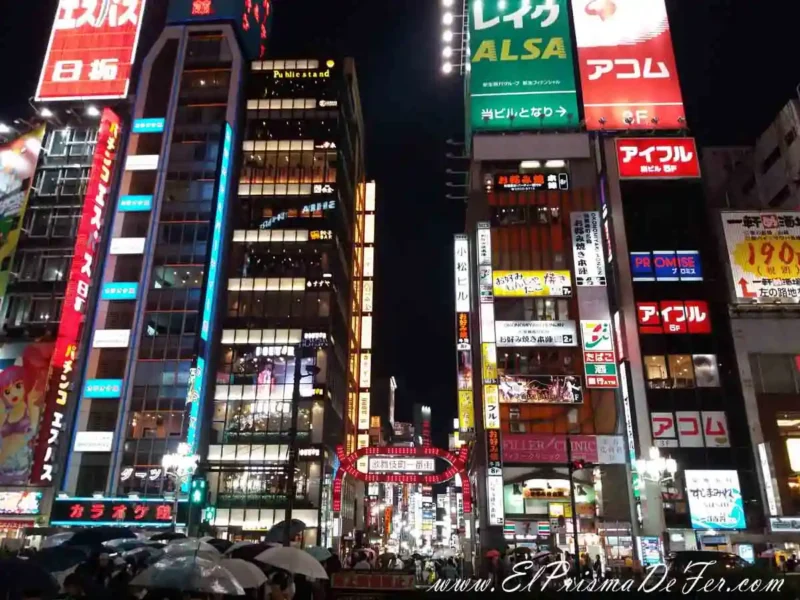
There is also a shopping area that is completely illuminated at night by the neon lights emanating from the street signs, similar to the movie Blade Runner.

You will see the Godzilla's head on the Toho cinema and other tourist places such as cafes with cats and owls, or the Robot Restaurant (where they have the least amount of robots :D). I didn't go to any of these last places; they are excessively expensive and very set up for tourists.

Day 3: Imperial Palace – Ginza – Tokyo Tower – Odaiba
– Imperial Palace
Another of the city's great recreational spaces, where the Imperial Palace is located. You can't see much more than a large gate, a bridge, and the wall surrounding the palace. But since it's a large space in a park, it's still pleasant to stroll through.

– Ginza
Another commercial district, full of stores featuring the world's biggest brands. Modern buildings and malls everywhere. Not my style, but you'll find a lot of life here.

– Tokyo Tower
Tokyo Communications Tower, modeled after Paris's Eiffel Tower. Until a few years ago, it was one of the city's most attractive spots due to the tower's height and its observation deck. However, since 2012, when the tower was inaugurated, Tokyo Skytree (the highest in Japan at 634 meters), this became secondary.

If you want to go up to the Tower's observation deck, you have to pay almost $30. Obviously, I didn't go up there, haha.
– Odaiba
One of the most interesting places to visit. It's a high-tech entertainment center on an artificial island. It can be accessed via the Rainbow Bridge by car, on foot or by taking the Yurikamome train.

There are many things to do on the island. For example, going to the beach that is next to the park (you can't get into the water), see the imitation of the Statue of Liberty, see a Gundman (giant robot from an anime) in real size, visit the shopping malls Aqua City and the Venice VenusFort, go to sushi bars with views along the promenade and even to a amusement park.

It is also home to one of the unique museums in the world, the Team Lab BorderlessIt's a digital museum, where each room features laser projections and lights that change over time. Admission isn't cheap—approximately $32—but it's worth it. For more information, visit: enter the museum's official website here.
Day 4: Yokohama – Roppongi Hills
– Yokohama
It's a port city near Tokyo. It's accessible by train and subway, which takes approximately one hour in total.
It's an interesting option to spend the day exploring the waterfront, the port, Chinatown, and some historic buildings. If you have free time and the weather is nice, it's a good idea to explore.

– Roppongi Hills
Another Tokyo neighborhood with shopping malls and great nightlife. There are many bars and clubs that fill up with tourists and locals at night to hang out.
Here we also find one of the best viewpoints to get incredible views of the city, the Mori TowerEntrance to the viewing platform costs approximately $18, and a little more if you go up to the terrace.
The best time to go up is before dusk, to see all the city lights come on. You'll find a lot of people at the viewing platform at the same time.

Day 5: Nakano Broadway – Asakusa (fireworks)
– Nakano Broadway
Another ideal place for the manga and anime fansJust like Akiahabara, Nakano Broadway also has a three- or four-story complex filled with shops selling geeky stuff for all tastes. Action figures, manga, clothing, and collectibles.
It's a bit far from the main tourist sites, but you can still get there easily by train.

– Asakusa (fireworks)
I was lucky enough to be present on the day of the Sumidagawa Fireworks Festival, which is held on the last Saturday of July in the Asakusa area. From approximately 8:00 p.m. to 9:00 p.m., a fireworks display lights up the Tokyo skies over the Sumida River. one million people They gather to see the 20,000 fireworks of all colors.
The number of people who gather early in the morning, arriving from all over the city to sit in the best spots and enjoy them, is impressive...more so than the fireworks, I'd say.
Streets blocked, corners packed with people, police directing traffic. I think it was the only time I've seen such chaos in Tokyo.

Day 6: Odaiba – Ginza – Akiahabara
This day, which was the last of my trip, I saved it to return to places I liked, and to see places I had missed.
I returned to Odaiba to go to the National Museum of Science and Innovation (Miraikan Museum)). In it you will find for example Asimo robot doing a demonstration or watching a short film with one of the best 3D effects I've ever seen. Admission is cheap. You can see more information on the official website of the museum.

In Ginza I went to see the clock designed by Hayao Miyazaki (the one I mentioned at the beginning), another monument to Godzilla (this time full body but smaller) and the building of the Tokyo Forum (with a very original design).

Finally, I returned to Akihabara to explore other places I had missed visiting the first time.
How to get around Tokyo
Their preferred mode of transportation is the subway. There's an extensive network of lines that crisscross the entire city.

Although looking at the subway map might make you think it's impossible to get lost, it's actually almost as easy as in any other city. The only difference is that there are two distinct networks operated by two independent companies: Tokyo Metro and Toei. Tickets from one network are not valid on the other.
But this won't be complicated. Nowadays, it's very easy to get around with an app like Google Maps. It will tell you the best way to get to a specific location, which subway to take, where to get off, which gate to exit at, and how much to pay...it couldn't be better.
He price The price of the ticket varies depending on the distance traveled. It can range from 170 yen (1 to 6 kilometers) to 310 yen (28 to 40 kilometers).
To travel you can use the preloadable cards, such as the card Suica/Pasmo (they can be purchased at any convivi in the city) or using regular currency like bills or coins. With cards, it's much easier and faster; just load them with enough credit and simply swipe them through the readers.
However, if you want to buy a ticket from an automatic ticket machine, you have to look for the name of the final station on your journey, see the fare, and then insert the money.
Is it worth using JR PASS in Tokyo?
Not really. I'd save it for long trips between different cities, for example, the Tokyo-Kyoto route or the Kyoto/Osaka-Hiroshima route.
In Tokyo, the JR Pass covers the YAMANOTE Line, the journey between Narita Airport and the city, and some other lines. However, you'll likely need to use other lines, which aren't included in the pass (due to proximity, convenience, or time).
So, if you're only going to buy the pass to be in Tokyo, I don't recommend it. If you're traveling to other parts of Japan, I would consider it. Keep in mind that you can always get to your destination using cheaper means than those included in the JR PASS (for example, buses or regular trains).
Is Tokyo expensive?
The answer to this question depends a lot on the country you live in. It's not the same if you live in Germany as it is in Argentina, for example. In my case, living in Argentina, I did find everything quite expensive in general.
You also have to consider the type of trip you're taking. For example, sleeping in hotels with three or more stars isn't the same as sleeping in capsule hostels, which tend to be the most affordable.
Transport
Transportation is expensive. The minimum fare on the Tokyo subway costs around US$1.70 and can exceed US$3 for longer distances.
Considering the great distances between tourist sites, we'll likely be traveling more than 1 meter a day to get around.
If we plan to travel 3 or more times, I would consider purchasing one of the day passes sold at the stations.
Meal
Eating out is also expensive. Except for the classic and delicious ramen, where prices can range from $3 and up, the few times I went to a restaurant, I paid a lot and the portions were small.
To avoid exceeding my daily budget, I bought pre-made meals from supermarkets or Convivi stores (7-Eleven, Lawson, Family Mart). They're meal trays with a good amount and variety of food (it can include rice, fish, chicken, and other ingredients). They're delicious, you can heat them up in the microwave right there, and you can even eat two servings because they're so large.
Where to stay in Tokyo
For accommodations, you'll find everything. There are very expensive hotels with onsen or traditional rooms, but you can also find fairly affordable alternatives in hostels or capsule hotels. I spent an average of $20 per night across Japan, staying in hostels with shared rooms (capsule-style beds).
In Tokyo, the most affordable areas with good locations are in the Asakusa district and its surroundings across the Sumida River or on the outskirts of the tourist center. However, I ruled out the latter option because what I saved on accommodation, I would have to pay for in transportation due to the distance.
The neighborhood of Asakusa I thought it was a good place to stay. It's a quiet, pretty neighborhood, close to the Ueno and Akiahabara districts, and not far from Ginza and the Imperial Palace. It's a little further from Shibuya, Shinjuku, Odaiba, and Roppongi Hills, for example.
During my 8 nights in Tokyo, I stayed in two hostels in Asakusa. The nicest was the Hiromas Hotel Kura (no longer available), followed by the TOKIO-W-INN Asakusa.
What is the best time to travel to Tokyo?
The best time to travel to Japan, considering the climate, would be spring and autumn, between April and May or October and November. These are the mildest and clearest months.
Spring (March, April, May)
In spring The temperature is pleasant and rainfall is not abundant, making it a good option for visiting Japan.
Traveling to Japan in spring offers the advantage of enjoying the blossoming trees that adorn the entire country. From mid-February to mid-March is the plum blossom season, and from mid-March to mid-April, the cherry blossom season. The trees are covered in shades of white and pink. It's ideal for exploring the rural landscapes and parks of the country's major cities.
Autumn (September, October and November)
Autumn It is one of the best times to travel to Japan, as the temperature is cool but pleasant, making it ideal for photography enthusiasts who can enjoy the reddish and yellow tones of the landscapes due to the changing color of the tree leaves.
September is still a month of heavy rainfall, especially due to typhoons.
As for the weather, October is one of the best months to travel to Japan, as the temperatures are warm and the days are much sunnier.
Because it's the shoulder season, it's a time of year when there aren't as many tourists in the big cities.
Summer (June, July, August)
During the summer in Japan, you'll need to consider the high temperatures and humidity found in the most touristy areas, especially Tokyo and Kyoto.
If you go from June to August, don't forget an umbrella and a raincoat, as it's the rainy season.
Winter (December, January, February)
In winter, the days are short and there is little rainfall. If you visit Tokyo, you'll enjoy cool temperatures and slightly humid weather.
If you decide to travel to Japan in winter, don't forget to bring warm clothing.
It's the cheapest time to plan your trip. However, hotels, train stations, accommodations, and attractions are busier, and prices rise from Christmas to New Year's.
Final thoughts on my visit to Tokyo
What else can I say? It was a dream come true for me. With everything I mentioned at the beginning, coming here was one of the most wonderful things that ever happened to me as far as travel goes.

It's a city I'd like to return to in the future and enjoy in a different way, more peacefully, and trying to connect a little more deeply with the locals. But hey, in a week of going back and forth to all the attractions, I couldn't have done much about it.
What I loved was finding these anime references everywhere. I came looking for that, in part, and I found it :D.
Frequently Asked Questions about Tokyo
How many days do I need to visit Tokyo?
Ideally, you should dedicate between 4 and 5 full days to Tokyo. This allows you to explore the main districts at a relaxed pace. If you have more time, you can add nearby day trips.
How to get around Tokyo?
Transportation is excellent. You'll mainly use:
- Metro (Tokyo Metro and Toei)
- Trains (like the JR Yamanote Line)
The most practical thing is to get a rechargeable card like Suica or Pasmo, which can be used to pay for everything without taking out tickets each time.
Is Tokyo expensive?
Tokyo can be expensive, but not necessarily:
- Accommodation: the most expensive
- Food: Affordable if you eat at local places
- Transportation: reasonable and efficient
You can travel on a backpacker's budget without any problem.
Where is the best place to stay?
Neighborhoods like Shinjuku and Shibuya are very convenient due to their connectivity and offerings, while Asakusa offers a quieter and more traditional experience.
What is the best time to travel?
Spring and autumn are usually the best times to visit due to the weather and scenery. Summer can be quite humid and hot, while winter is colder but also more affordable.
Can it be managed using only English?
Generally, yes. Although not everyone speaks English, the city is well-prepared for tourism, with clear signage and user-friendly systems. With tools like offline maps or translation apps, you won't have any problems.
Is it easy to find food?
It's a city where eating is never a problem. There are options on every corner, from restaurants to 24-hour shops. What's more, it's possible to eat well without spending too much.
Is cash or card used?
Although cards are increasingly accepted, Japan remains quite cash-friendly. It's advisable to carry cash or withdraw money from ATMs.
Do I need a plug adapter?
Yes. In Japan they use type A plugs (like in the US) and 100V. You'll need an adapter.
Are day trips from Tokyo worthwhile?
Yes, that's a very good idea. Places like Nikko, Kamakura, or Hakone can be visited in a day and complement the city experience very well.
Support The Prism of Fer!
Your support helps me continue creating free content on the blog. Thank you so much!