Traveling in China means adapting to a digital ecosystem completely different from the one we use in the West. Many of the apps we take for granted, such as maps, messaging, transportation, or payments, are not available. Instead, the country has its own platforms that concentrate almost all of daily life on your mobile phone.
The good news is that, once you understand which apps you need and how to set them up, everything becomes more manageable.
In this post I'm going to tell you which apps to install before traveling to China, which ones are essential, which ones are optional but very useful, and how to use them in practice to get around, pay, translate, and organize your day-to-day life without depending on the language or cash.


This post may contains affiliate links. If you purchase through these links, I may earn a commission at no extra cost to you. Thank you for your support!
Table of Contents
First of all, download a VPN
Before we talk about any other app, there's one in particular that you need to install before entering China, and that's a VPN.
A VPN (virtual private network) allows you to connect to servers outside of China and access those services as you normally would.
Many Western services are blocked or unreliable within the country (Google, Gmail, Google Maps, Instagram, WhatsApp, etc.). If you don't set up a VPN before crossing the border, downloading or activating one afterward can be difficult.
In my case I tried two:
- Surfshark: It worked, but with quite a few ups and downs. It wouldn't be my first choice if I were to travel again.
- Hotspot Shield: It worked much better for me. It connected quickly and was more stable during daily use. It has a free version if you watch ads.
This information may change over time, as VPNs in China always depend on updates and dynamic blocking, but the important thing to know is that you don't have to travel without a VPN already installed and tested.


Apps for booking hotels in China
Finding and booking accommodation in China can be very simple if you use the right platforms, especially since many international apps work better than local ones for those of us who have cards and profiles outside the country.
Trip.com
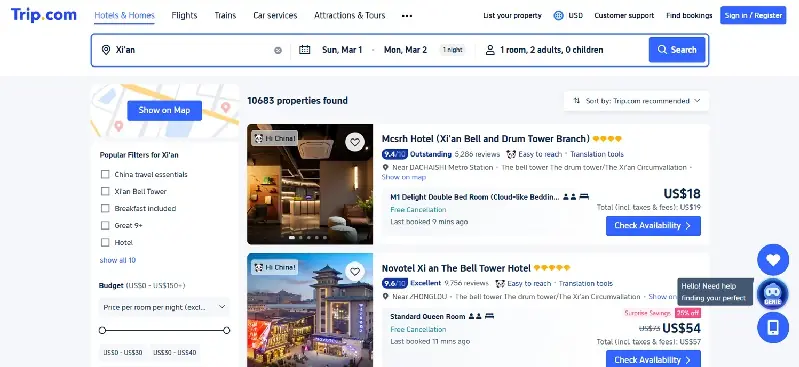
The most recommended option for foreign travelers is Trip.com. It has:
- Search for hotels, hostels and guesthouses across the country
- Filters to select accommodations that accept international guests
- Payment by international card directly
- Immediate confirmation and multilingual support
In many Chinese cities, including smaller ones, Trip.com offers greater availability and clarity than other apps. It's especially useful if your itinerary includes stops in less touristy areas.
Booking.com
Booking.com also works well in China. It has a familiar interface and flexible cancellation options for many properties. However, its selection is sometimes much more limited than Trip.com.
Airbnb
Airbnb is available in China, but its offerings aren't as extensive outside of major cities. However, it can be a good alternative if you're looking for more "homey" accommodations or something different from traditional hotels.
Tips for booking accommodation
- Check that they accept foreigners. Not all accommodations in China can register non-Chinese passports, and this is something the app usually indicates in the hotel's listing.
- Please read the cancellation and check-in information carefully. Policies may differ from those typically found in the West.
- Book in advance during peak season. During Chinese holidays such as Golden Week or Lunar New Year, accommodations can fill up quickly.

Apps to communicate with local people
If you're going to interact with people in China, whether it's a guesthouse owner, a tour guide, someone you meet on a train, or even a business contact, there's one app that everyone uses.
WeChat is the dominant messaging app in China. It's much more than a chat app; it functions as a social network, digital wallet, professional networking platform, and everyday tool for everything.
If you want to contact someone local, they'll most likely ask for your WeChat QR code to add you. They don't use WhatsApp or Instagram, they use WeChat.
My advice is to download and configure it before traveling, but be aware that activation may require verification by another user who is already using it.
Apps for paying in China
China is now a largely cashless society. In many places, especially smaller shops and street stalls, foreign cards are not accepted, and paying with cash can even be inconvenient. Therefore, it's important to have the right apps set up before you travel.
Alipay
Alipay is the leading payment platform in China. It allows you to link international cards (Visa and Mastercard in many cases), although identity verification may be required. Payment is made simply by scanning a QR code.
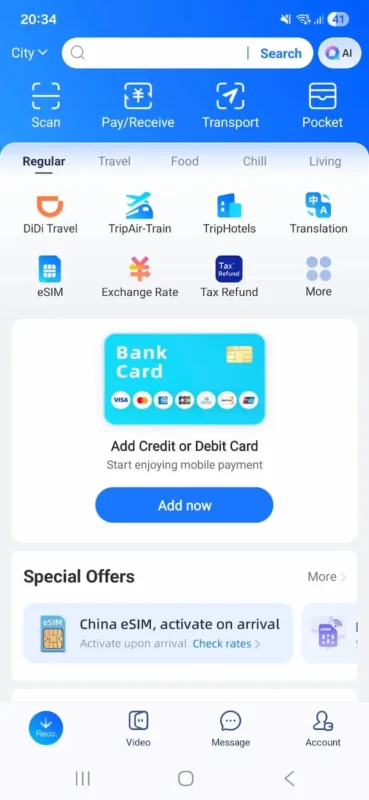
In addition, within the app you can access mini-programs for public transport, bike rental and other services, making it even more practical for travelers.
Personal tip: if I had to choose one, I found Alipay easier to set up as a foreigner. But ideally, you should have both active. In China, paying with QR codes isn't just another option: it's the standard way to get around.
WeChat Pay
WeChat is the other major payment app. It works very similarly to Alipay: you link your foreign card and pay via QR code. But it's also a messaging app and is used for absolutely everything.
While it's very useful for communicating with other people in China, I found it more complicated to link my international cards to the app. Several times I encountered errors or couldn't complete the validation, so I finally opted to use Alipay for payments, where the process was much simpler.
Map apps for traveling in China
It's virtually impossible to navigate China without maps, but there's an important detail: the most popular map apps (like Google Maps) don't work well or are simply blocked. Therefore, you need to prepare alternatives that allow you to navigate and find directions without relying on services that don't operate within the country.
Amap (Gaode Maps)
The most popular map app among locals is Amap (also known as Gaode Maps). It has:
- Detailed maps of all of China
- Directions for walking, public transport and driving
- Information on trains, stations and timetables
- Search for places and businesses located
It's the most accurate and up-to-date option for urban and regional routes. It's designed for a local audience, so the interface may be mostly in Chinese. But with patience (and, if needed, the screen translator), it's the most useful tool for getting around.
Baidu Maps
Another popular alternative is Baidu Maps, which offers similar coverage and also routes for public transport and driving. Like Amap, it may require some patience if you don't read Chinese, but it's very comprehensive.
Offline Maps
If you don't want to depend on Chinese apps or a constant connection, downloading offline maps is very useful. Apps like Maps.me or the offline function of HERE WeGo allow you to have maps downloaded by city or region and use them without internet. They won't always have all the updated local names, but they work well for basic navigation.
Tips for getting around in China
- Download offline maps before you travel. This way you'll have a reference point even without data or an internet connection.
- Install several: if one frustrates you, perhaps another will be more enjoyable.
- Use the photo translator if you need to read characters from the app. It can help you navigate features or searches more easily.
Applications for transportation within China
To get around within and between cities, there are several apps that greatly simplify logistics, from booking trains to ordering cars or viewing local transport.
Trains and intercity transport
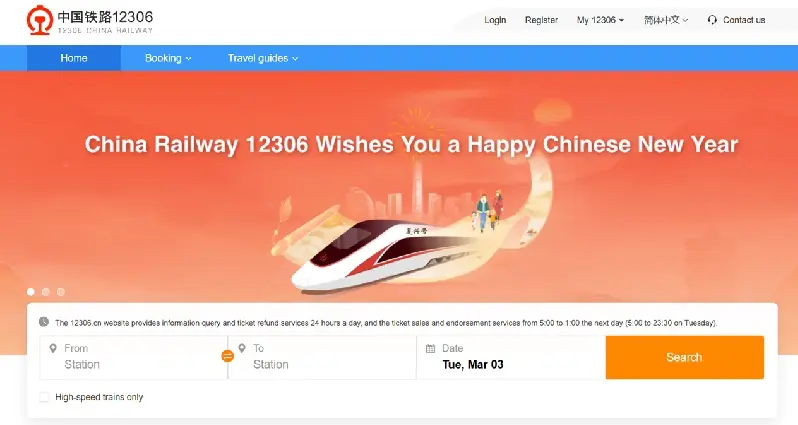
12306 (China Railway)
The official app for booking China Railway trains is 12306. You can search for schedules, buy tickets, and show your QR code ticket at the station. It has an English version and is the most direct way to buy tickets without intermediaries.
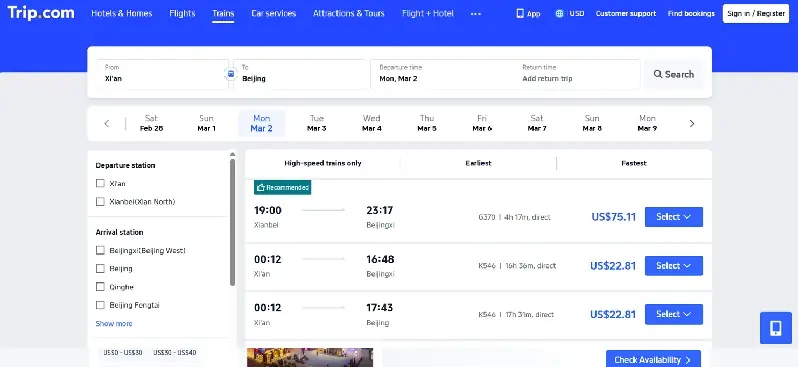
Trip.com
Although not a transportation app per se, Trip.com allows you to easily purchase train and flight tickets with an international credit card. It's simpler for foreign travelers than the official app if you're just starting out.
Taxi and urban travel: DiDi
The most used app for urban transport is DiDi, the equivalent of Uber in China. With DiDi you can:
- Order cars easily
- Choose your trip type (from economy to premium)
- Check destination and price before confirming
- Pay directly from the app (or with the linked card)
It works very well in large and medium-sized cities, and is often more convenient and straightforward than taking a traditional taxi if you don't speak Chinese.
Subway and buses
Local subway apps often appear within Amap or Baidu Maps, so you can use them to view public transport routes and times. In many cities, you don't need a specific app to enter the subway; you can use the QR code generated by Alipay or WeChat Pay to enter the stations directly.
Shared bicycles and scooters
China has a huge system of shared bicycles and scooters, integrated with QR codes. The most common apps to unlock them are:
- Mobike
- Meituan Bike
- Hello Bike
These work by scanning the bike's QR code with your payment app (like Alipay) and are ideal for short distances or for getting around neighborhoods.
Tips for getting around cities
- Have DiDi installed and linked to your payment method. It's the most practical urban transportation app.
- For long trains, use 12306 or Trip.com. If you're not familiar with 12306, Trip.com is more intuitive.
- Maps and local transport go hand in hand. Amap or Baidu show you routes and metro/bus combinations in almost every city.
With these apps, you have virtually all your transportation needs covered, whether within a city or between regions. This makes traveling around China much smoother than it initially seems.
Language applications
If there's one thing you really need in China, it's a good translation app. English isn't as widespread as in other Asian destinations, so your phone becomes your best ally for communication.
Google Translate
Google Translate is very useful, especially if you download the Chinese language pack for offline use. Additionally, if you're connected to the internet, you can use the camera translation feature. This is useful for translating menus, signs, and other visual cues.
WeChat for chats
WeChat has a built-in feature to translate messages within chats. If someone writes to you in Chinese, you can press and hold the message to automatically translate it.
iPhone Translate app
If you use an iPhone, the native app Apple Translate works very well. It allows real-time voice translation, ideal for simple face-to-face conversations. It also offers offline mode if you download the language beforehand.
Frequently asked questions about which apps you need in China
Which apps are essential?
For me, the basics are:
- Alipay (payments)
- WeChat (communication and payments)
- Maps.me with Baidu Maps
- Google Translate or an offline alternative
- Trip for trains and hotels
- VPN
Is it possible to pay with a foreign card without apps?
In theory, yes, in large hotels or very international places. In practice, it's not the norm. Even small restaurants or shops exclusively use QR codes. The most convenient option is to set up Alipay or WeChat before traveling.
Does Google work in China?
Google services may be restricted. Sometimes they work, sometimes they don't. It's recommended to download offline maps and languages before you arrive.
Do I need a VPN?
It depends on how much you rely on Western services (Google, Instagram, WhatsApp, etc.). It's not mandatory for getting around within China, but it can be useful if you want to access those platforms.
Can I travel with just cash?
I don't recommend it. Although cash is still legal, many places simply don't expect it or don't have change. China is, in practice, a digital society.
Support The Prism of Fer!
Your support helps me continue creating free content on the blog. Thank you so much!