If there's one thing that immediately comes to mind when we think about traveling to China, it's visiting the Great Wall of China, one of the seven wonders of the modern world. If it's your first time in the country, you're probably wondering how to visit it, and the good news is that it's not that complicated to organize it yourself from Beijing.
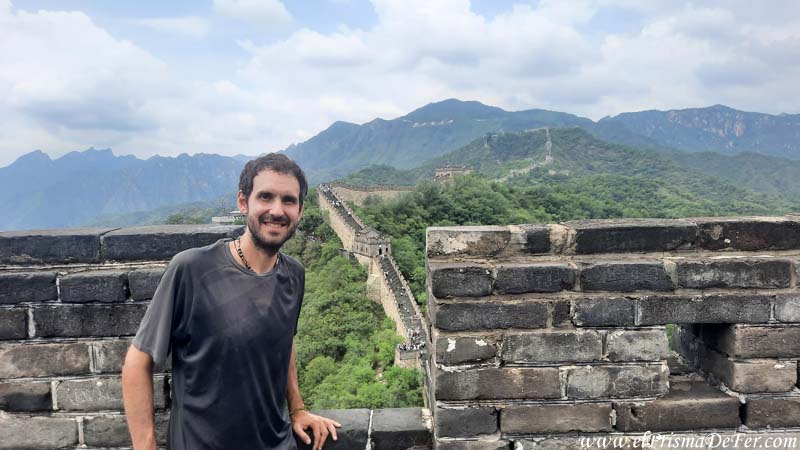
In my case, I had the opportunity to visit the Mutianyu section, and besides being a good choice because it is well preserved and practical, it helped me to complete a small personal goal; with this visit I completed the list of the seven wonders of the modern world.
In this post, I'll tell you how to visit Mutianyu with all the practical information: how to get there, how much it costs, and some useful tips. I'll also give you an overview of the other most popular sections of the Great Wall so you can compare and choose the one that best suits your trip.


This post may contains affiliate links. If you purchase through these links, I may earn a commission at no extra cost to you. Thank you for your support!
Table of Contents
Where is the Great Wall of China located?
The Great Wall of China isn't located in a single point, but stretches for thousands of kilometers across northern China. However, most travelers visit it from Beijing, as several of the most accessible sections are relatively close to the city.
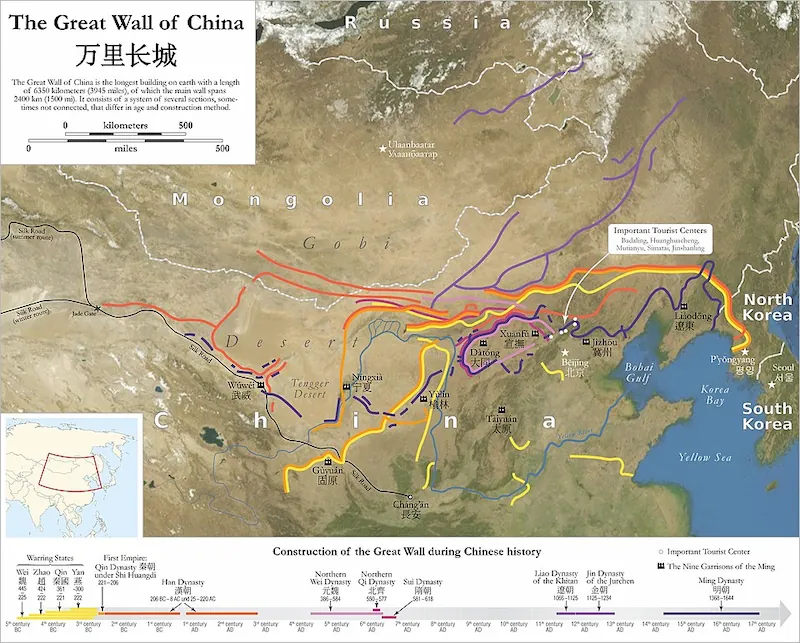
The Mutianyu section, which is the one I chose, is located about 70 km northeast of Beijing. Depending on your mode of transport, the journey usually takes between 1.5 and 2 hours.
It is one of the best located areas for a day trip, with good road access and options for both public and private transport.
Besides Mutianyu, there are other sections relatively close to Beijing such as Badaling, Jinshanling, and Jiankou, each with its own characteristics. But in terms of location and ease of access, Mutianyu is one of the most convenient without being as overcrowded as others.

When and how was the Great Wall of China built?
The Great Wall of China was not built all at once, but is the result of different stages over more than 2,000 years.
The earliest sections date back several centuries before Christ, when various kingdoms built walls to defend their territories. Later, during the Qin dynasty (around the 3rd century BC), many of these sections were unified.
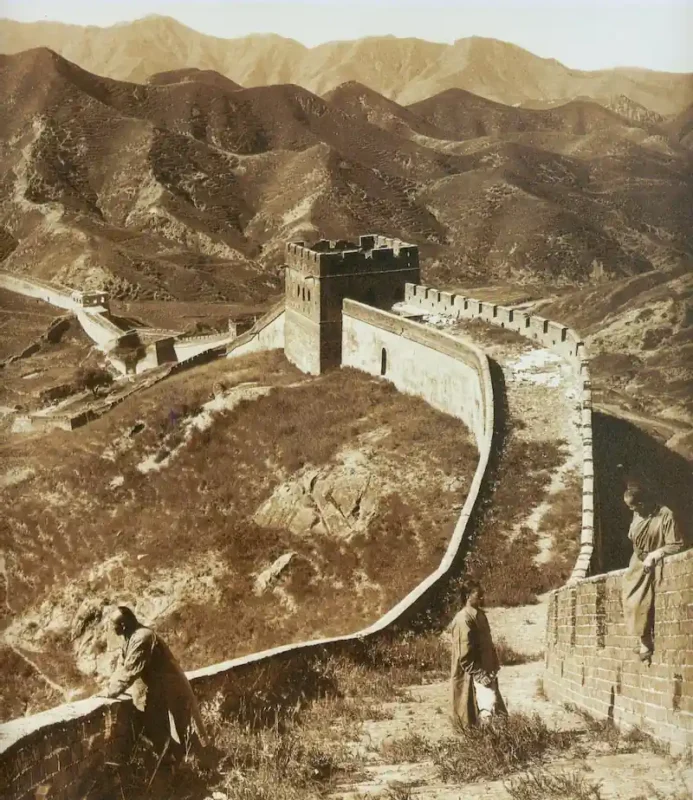
Most of what can be seen today, especially in areas near Beijing, was rebuilt and reinforced during the Ming Dynasty (14th to 17th centuries). Brick and stone were used during this period, giving it the more solid and recognizable form it has today.
As for its construction, it was an enormous undertaking carried out under quite harsh conditions. Soldiers, peasants, and prisoners all participated, transporting materials by hand across mountainous terrain. More than a continuous wall, it is actually a defensive system with watchtowers, strategic passes, and fortifications adapted to the terrain.
Which sections of the Great Wall of China can be visited?
As I mentioned before, the Great Wall of China isn't a single point; there are several sections open to tourists, especially around Beijing. The difference between them lies in how restored they are, the number of visitors, and how difficult they are to access.
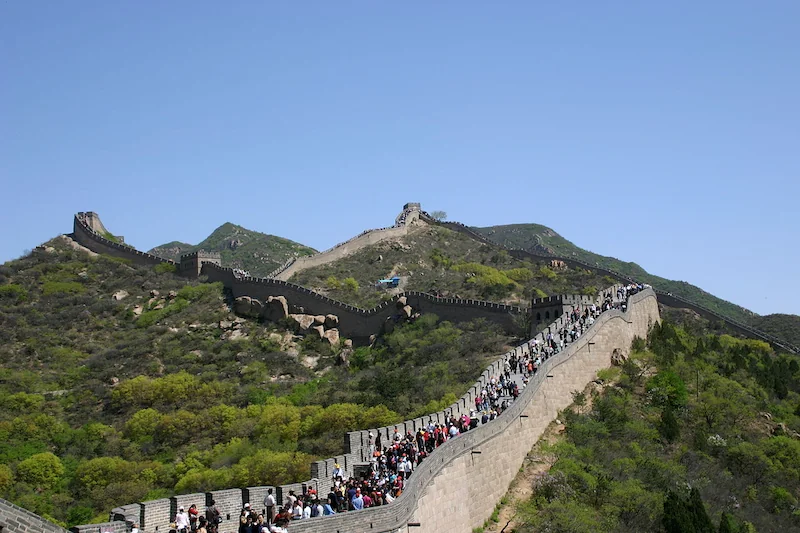
The most well-known is Badaling. It's the closest and most accessible, which is why it's also the most touristy. It's completely restored, has a cable car and all the amenities, but it's usually very crowded.
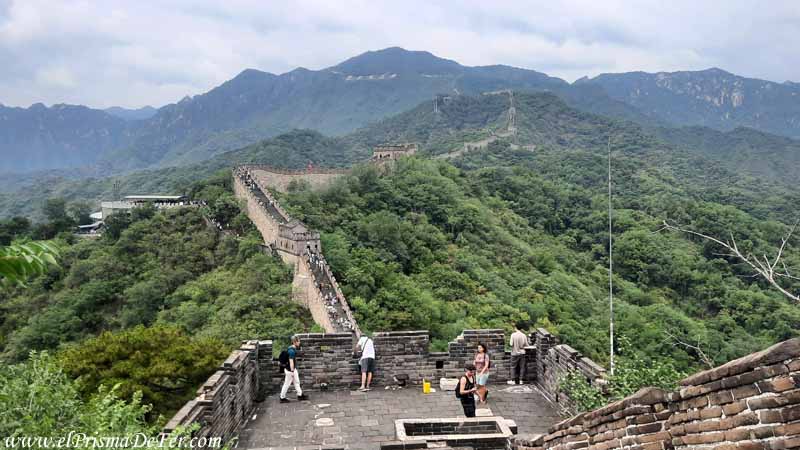
Another very popular option is Mutianyu, which is the one I chose. It's also well-restored, but it's usually less crowded than Badaling. Plus, it has great views and practical options like a cable car or even a toboggan run down.
If you're looking for something a little more authentic, Jinshanling is a great alternative. It combines restored sections with more original ones, and is quite popular for trekking.
Finally, for the more adventurous, there's Jiankou. It's an unrestored, wilder, and more challenging section, with parts in poor condition. It's not the best option if it's your first time, but it is if you're looking for a more immersive experience.

How do I get to the Badaling section of the Great Wall of China?
The Badaling section is the easiest to visit from Beijing, and therefore also the most popular. Although I didn't go to this part, it's probably the best connected and the simplest to organize on your own.
The most convenient way is by public transport. You can take a train from Beijing North Station (see on map) which takes you directly to Badaling (see location) in approximately 20-30 minutes. It's advisable to buy tickets in advance, as demand is high and they sell out quickly.
Once you leave Badaling station, you'll see a bus parking area on a slope. From there, you have two main ways to get up: cable cars go up the hill, and "ground cars," which are like larger cabins that also operate by cable, go down.
Tickets are purchased separately: one for access to the city walls and another if you wish to use these modes of transport. Both can be purchased directly at the ticket offices on site; advance booking is not required.
Another option is to book a tour or go by private car, which is quite common if you want to avoid complications. In all cases, it's a day trip that can easily be done.
Badaling prices and schedules
For Badaling, the entrance fee is around 40 RMB, and the means of going up (cable car or cable car) also cost between 80 and 120 RMB per leg.
The opening hours are usually a little longer than in other sections, generally from 7:30 until 17:30 or 18:00.
You can check the latest news about prices and schedules on the Badaling official website
Visiting the Great Wall of China from the Mutianyu section, my experience
I chose to visit the Mutianyu section, and overall I thought it was a very good option for a first-timer. To get there from Beijing, I combined the subway and two buses.
How to get to the Mutianyu section from Beijing
First, I took the subway to Dongzhimen (lines 2 or 13), which is where several buses depart for the outskirts of the city. The long-distance bus station is located there, and from that point you can take the 916 Express bus to Huairou Beidajie.
The journey takes approximately 1 hour or a little more, depending on traffic. Once you arrive in Huairou, you have to take a local bus (like the H23, H24, H35 or H36) which drops you off near the entrance of Mutianyu (see location). This last leg adds another 30-40 minutes. In total, allow between 1.5 and 2 hours for the trip.
There is also the option of taking a tourist bus directly from Dongzhimen that goes without transfers, but it is usually a bit more expensive or has more limited schedules.
While waiting for the second bus, I ended up meeting a local young woman and a Spanish couple, who were also going to visit the Wall, so without planning it, we ended up doing the whole visit together.
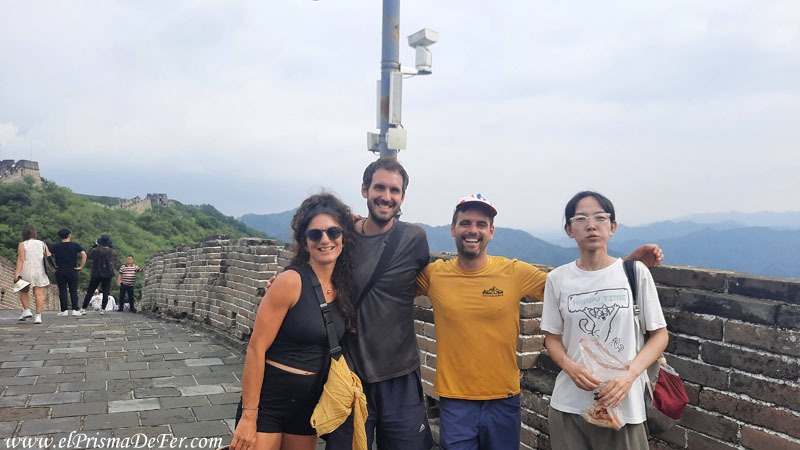
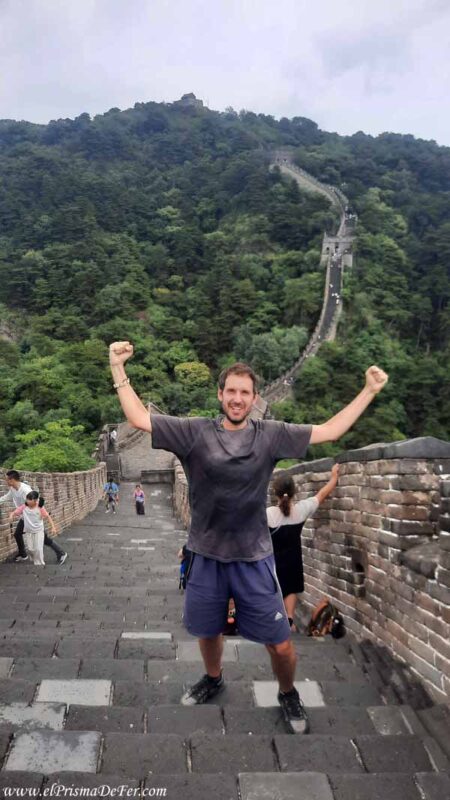
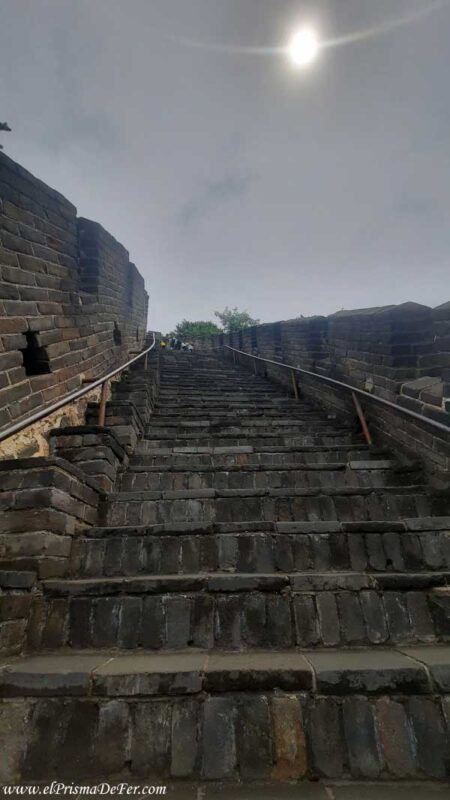
Once at the entrance, I bought my ticket (no need to buy it in advance) and decided to walk up the stairs instead of taking the cable car or any other means. There were hardly any people in that area, which was a welcome relief.
For me, the effort is worthwhile because you gradually reach the wall little by little. But once you're up there, more people start to appear. It's not overcrowded, but it's not as empty as one might wish.
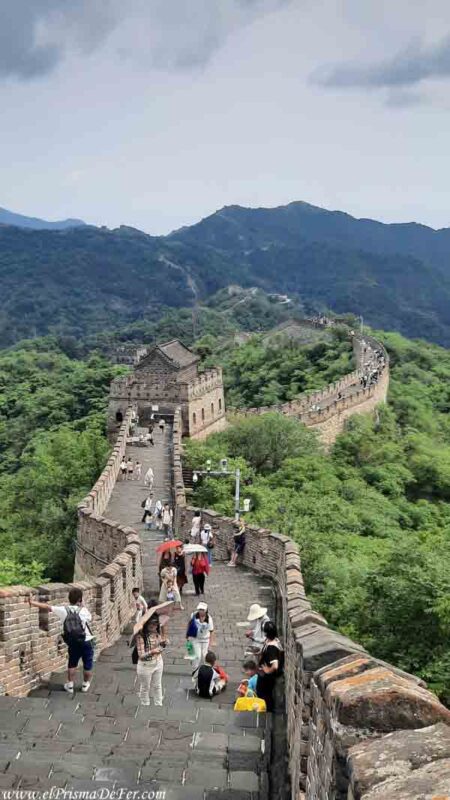
What is a visit like to the Mutianyu section of the Great Wall of China?
The wall at Mutianyu is very well preserved, completely restored, and is long enough to walk from one end to the other.
It has a restored length of approximately 5.4 km, with around 20 watchtowers along the way. It's quite a long walk, and it also has constant ups and downs, so it's not a completely flat route.
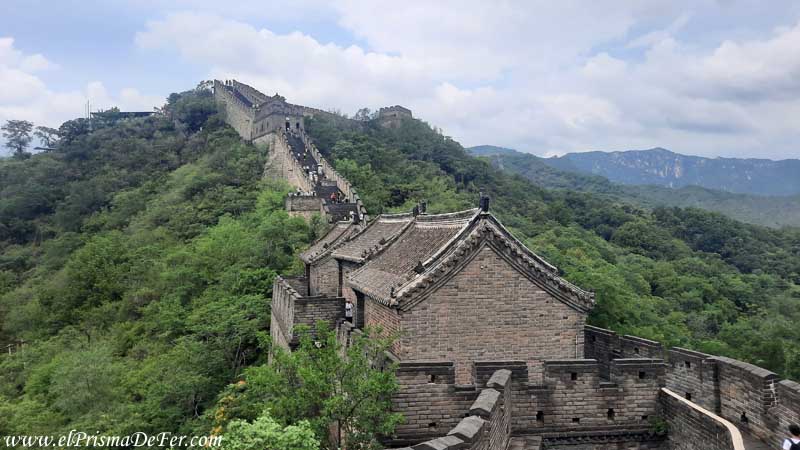
Personally, I would have liked to see it a bit more "wild," with more signs of age or vegetation, but that's not the case in this section; everything is quite renovated. Even so, it's still impressive.
The panoramic views from various points are excellent and really give you a sense of how enormous it is. There are areas where people congregate, but also others where you can walk around more peacefully.
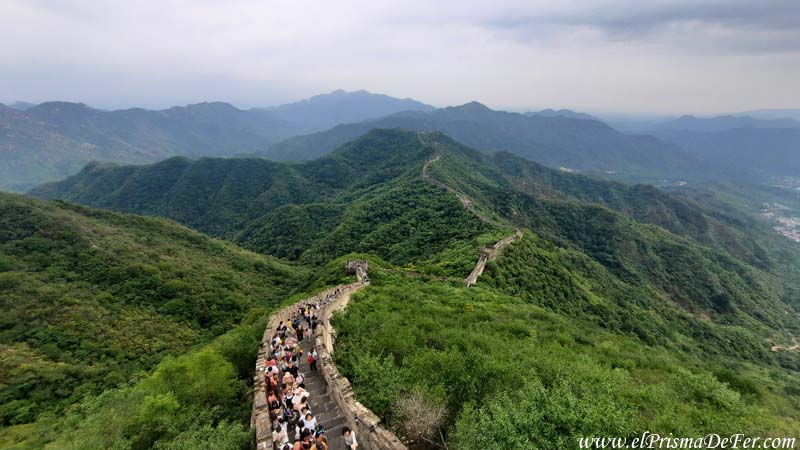
I truly enjoyed my visit to the Great Wall. Beyond the place itself, which is obviously impressive, it had the added personal benefit of fulfilling a goal I'd had for years: to visit all the wonders of the modern world.
How long does it take to visit the Great Wall of China in the Mutianyu section?
As for how long it might take, it depends a lot on how far you want to go and at what pace. If you do a short section, it could take you 2 to 3 hours, including the uphill and downhill sections. But if you take it easy and walk quite a bit from one end to the other, it's easy to spend 4 to 5 hours without any problem. Some people even spend half a day there.
How to return to Beijing from Mutianyu
To return to Beijing, you basically do the same route in reverse. From Mutianyu take the local bus to Huairou, and from there the 916 Express back to Dongzhimen, where you can reconnect with the subway.
It's quite simple, although it's a good idea to keep an eye on the last bus schedule so you don't run out of options, especially if you stay late at the city wall.
Mutianyu prices and schedules
In the case of Mutianyu, the entrance fee is usually around 40–45 RMB. If you want to go up or down by cable car or chairlift, each leg costs approximately 100–120 RMB. There is also the option of taking the toboggan down, which has a similar price.
As for opening hours, it is usually open between 8:00 and 17:00 or 18:00, depending on the season.
You can check the latest news about available slots, prices and schedules on the official Mutianyu Great Wall website
Other sections of the Great Wall of China to visit
Jinshanling: ideal for walking
The Jinshanling section is one of the best options if you want to explore the Great Wall on foot and experience a more authentic feel. It combines restored sections with more original ones and is quite long, making it very popular for trekking and even for hiking the stretch to Simatai (another section).
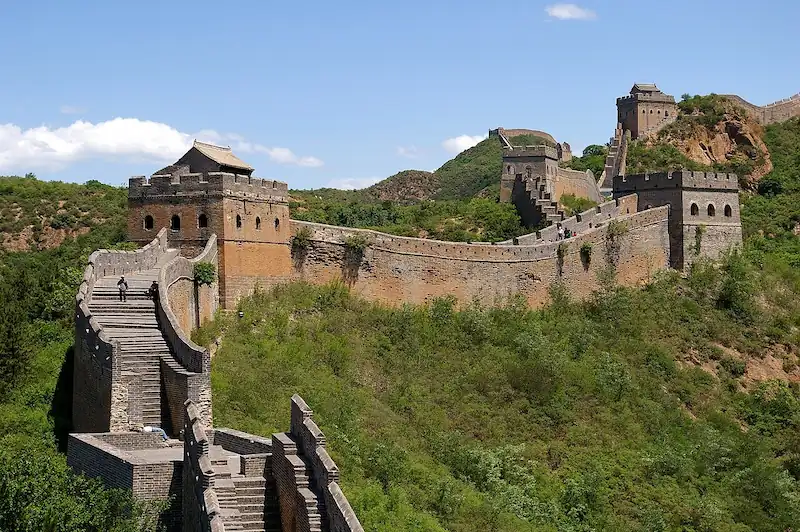
To get there from Beijing, the most common options are by bus plus local transfer or directly on a tour/private car. You can take a bus from Dongzhimen to Luanping or nearby areas, and from there a taxi or local transport to the entrance.
It's a bit longer than Mutianyu; allow between 2.5 and 3 hours of travel time. That's why many people choose to book a tour or drive to make things easier.
Jiankou: the wildest option
The Jiankou section is completely unrestored, the terrain is uneven, and it has some quite challenging stretches. It's one of the most photogenic parts, but also one of the most difficult, so it's not the best option if it's your first time on the wall.
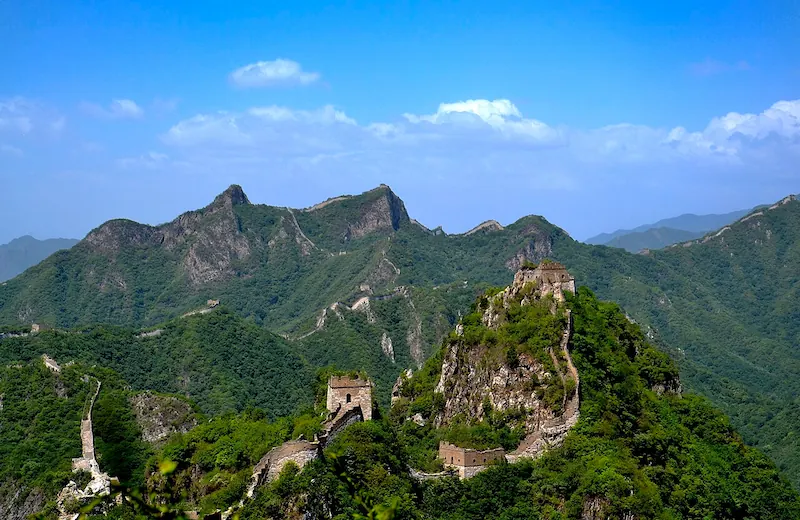
To get there from Beijing, the logistics are similar to Mutianyu for the first part: you can take a bus to Huairou. From there, instead of continuing on to Mutianyu, you need to take a taxi or local transport to one of the access points (such as Xizhazi or Jiankou village). The total journey also takes around two hours or a little more.
It's a much less organized visit; there's no tourist infrastructure like in other sections, and in many cases it's combined with hikes to nearby areas like Mutianyu. Ideal if you're looking for something more adventurous and off the beaten track.
Best time to visit the Great Wall of China
The Great Wall of China can be visited year-round. In general, spring (April–May) and autumn (September–October) are the best times. The weather is milder, there is less humidity, and the scenery is at its most beautiful, especially in autumn with the vibrant colors of the trees.
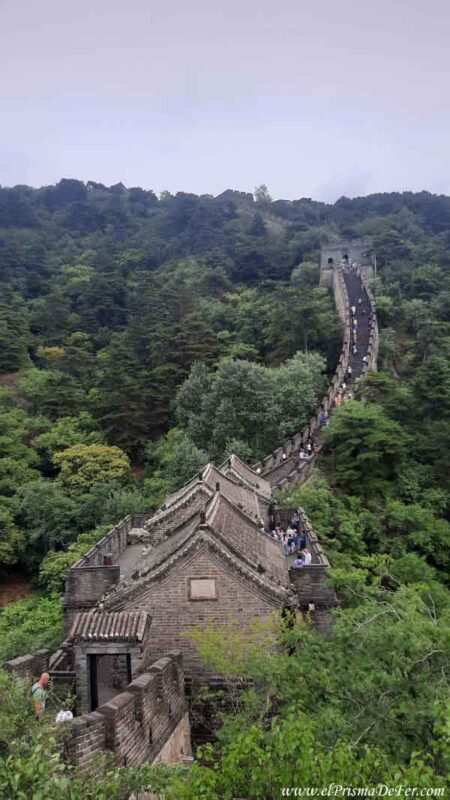
Summer (June–August) is also an option, but it can be quite hot and humid, as well as being peak season, which means more people in sections closer to Beijing such as Mutianyu or Badaling.
The winter (November–March) has its interesting side, with fewer tourists and landscapes that, if you're lucky, might be snow-covered. But you also need to be prepared for the cold, the wind, and potentially slippery areas, which can make your visit a bit more uncomfortable.
Final thoughts on my visit to the Great Wall of China
Visiting the Great Wall of China is undoubtedly a must if you're in Beijing. It lives up to expectations: it's imposing, easy to visit, and steeped in history.
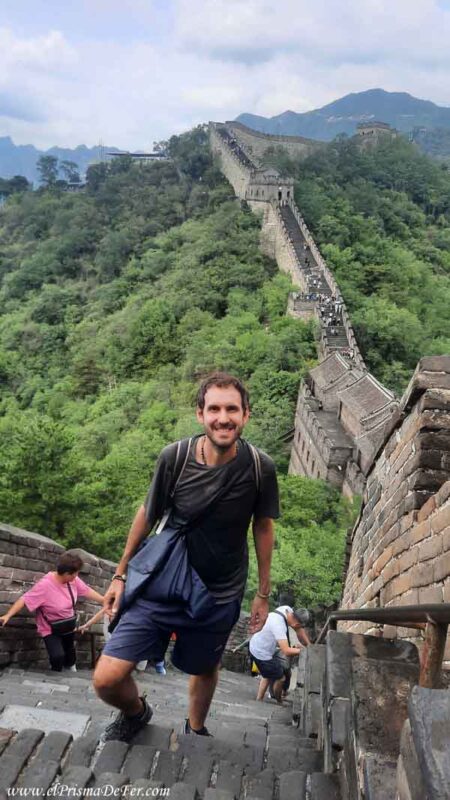
However, if I were to return a second time, I would probably try to go to a less crowded section. Even in places like Mutianyu, where there are supposed to be fewer people than in other parts, there's still quite a lot of activity, and that sometimes takes away a bit of the magic of the experience.
And, on a personal level, it wasn't the modern wonder that impressed me the most. I think places like Petra or Machu Picchu impressed me much more. But that doesn't diminish its merit; the wall remains a gigantic work, unique in the world and totally worthy of admiration.
Frequently asked questions about visiting the Great Wall of China
Which is the best section to visit?
It depends on what you're looking for. Mutianyu is one of the most balanced (accessible and not too crowded), Badaling is the easiest but also the most touristy, and options like Jinshanling or Jiankou are more for those looking for something different or more adventurous.
Can you visit independently or is a tour recommended?
It's perfectly possible to do it independently from Beijing using the subway and bus. Tours or private cars are more convenient, but not necessary.
How much time do I need?
It's a half-day to full-day excursion. Between the trip and the visit, you should normally dedicate at least half a day, although if you enjoy walking you could spend several hours exploring the wall.
Is it very difficult to walk it?
There are sections with many stairs and slopes, but overall it's not technically difficult. The important thing is to wear comfortable shoes.
Are there many people?
Yes, in almost all the more accessible sections. Even Mutianyu is usually quite crowded, though not as much as Badaling. If you want to avoid crowds, it's best to go early or choose less popular sections.
Was the Great Wall of China built to stop the Mongols?
Yes, one of the main objectives of the Great Wall of China was to defend Chinese territory from invasions from the north, especially from nomadic peoples such as the Mongols.
Support The Prism of Fer!
Your support helps me continue creating free content on the blog. Thank you so much!